

EU VAT for SaaS
When you sell SaaS to a consumer in the EU, you charge VAT at the rate of the consumer's country. When you sell to a VAT-registered business in another EU country, you usually charge no VAT, and the business accounts for it under the reverse charge.
This guide explains those two rules, the exceptions that matter for a small SaaS business, and what your invoices must show. It ends with how to set this up in Two Minute Billing.
Do I charge VAT to EU customers?
Usually, yes. A service delivered over the internet, essentially automated and with minimal human intervention, is an electronically supplied service in EU VAT law. The VAT Directive lists "supply of software and updating thereof" and "website supply, web-hosting" among them. The Commission's explanatory notes on these services quote the definition and the list in full.
What you charge depends on two things: whether the customer is a consumer or a business, and where they are.
- Consumer anywhere in the EU — you charge VAT at the rate of their country.
- Business in another EU country — you usually charge no VAT. The customer accounts for it.
- Business in your own country — you charge your normal domestic VAT.
The Your Europe page on cross-border VAT states the rule plainly: telecommunications, broadcasting and electronic services "are always taxed in the customer's country". For business customers, "you don't usually need to charge your customers VAT".
How do you tell a business from a consumer? Mostly by the VAT number. The Commission's notes say you may treat a customer who gives you no VAT identification number as a consumer. If they give you one later, you must review that treatment and correct it, which can mean refunding VAT you charged.
Which country's VAT rate applies?
For a consumer, the rate of the country where they live. Under Article 58 of the VAT Directive, the place of supply is where the consumer "is established, has his permanent address or usually resides". Each country sets its own standard rate, which cannot be less than 15%. The Your Europe VAT rates page lists them: 19% in Germany and 20% in France, for example.
Here is one €29.00 monthly plan, sold to four customers.
Seller: a SaaS business established only in Germany, VAT-registered there, with cross-border consumer sales above €10,000 a year. Prices exclude VAT.
| Customer | VAT treatment | VAT | Customer pays |
|---|---|---|---|
| Consumer in France | French rate, 20% | €5.80 | €34.80 |
| Business in the Netherlands, valid VAT number | Reverse charge | €0.00 | €29.00 |
| Business in Germany | German rate, 19% | €5.51 | €34.51 |
| Consumer in Germany | German rate, 19% | €5.51 | €34.51 |
For the French consumer, you owe the €5.80 to France, not to Germany. You either register for VAT in France or declare it through the One Stop Shop (see below).
A seller in the United States charges the French consumer the same 20%, from the first sale. It has no home EU rate, so every EU consumer sale is taxed in the customer's country.
You must be able to show where the customer is
The VAT Implementing Regulation sets out how you decide where a consumer lives. Where no specific presumption applies, the general rule is that you identify the place from two items of non-contradictory evidence. Article 24f lists examples: the customer's billing address, the IP address of their device, and bank details such as where the paying account is held. The Commission's notes explain each item.
Collecting and keeping that evidence is your job. A billing system that records only an address does not do it for you.
What is the reverse charge?
The reverse charge moves the duty to account for VAT from you to your business customer. Article 44 of the VAT Directive places a business-to-business service where the customer "has established his business". When that is a different EU country from yours, the Commission's notes say the supplier "should not charge VAT as it will be for the customer to account for the tax under the reverse charge mechanism".
The same applies when the seller is outside the EU. The Your Europe cross-border page tells EU businesses that for services bought from outside the EU, VAT is usually paid at their own country's rate under the reverse charge.
You still issue an invoice. It shows no VAT and must carry the words "reverse charge" (see What must a VAT invoice show?).
How do I check an EU VAT number?
Use VIES, the European Commission's VAT Information Exchange System. The Your Europe page on VIES links to the free checker. Some facts from that page worth knowing:
- VIES is "a search engine (not a database)". It asks each country's national register.
- The answer is valid or invalid. A number can be invalid because it "has not been activated for intra-EU transactions".
- The service is "sometimes not available due to the need to back-up the national databases". The advice is to wait a few minutes and try again.
- If your customer says they are registered but VIES does not confirm it, they can ask their own tax office to check.
- "It is recommended that you keep track of your validation in case of tax control."
A VIES result helps you decide that a customer is a business. It does not set the VAT treatment.
Is there a VAT threshold for SaaS?
Only for some EU sellers. The One Stop Shop page and the Commission's explanatory notes on the e-commerce rules (section 3.2.7) describe a €10,000 threshold. Your consumer sales to other EU countries stay taxed in your own country if all of these are true:
- You are established in only one EU country.
- You sell electronic services to consumers in other EU countries.
- Those sales, plus any intra-EU distance sales of goods, total €10,000 or less (excluding VAT) in the current and the preceding calendar year.
Below the threshold, the German seller above would charge the French consumer 19%, not 20%. As soon as the total passes €10,000, the general rule applies and the customer's country rate takes over. You may also choose the customer's country rate earlier. That choice binds you for two calendar years.
The threshold does not apply to a seller established outside the EU. A US SaaS business charges VAT at the customer's country rate on the first sale to an EU consumer.
What is the One Stop Shop (OSS)?
The OSS lets you declare and pay VAT due in other EU countries through one portal, instead of registering in each country. According to the One Stop Shop page:
- You register in one EU country, your "Member State of identification".
- The Union scheme is for businesses established in the EU.
- The non-Union scheme is for businesses with no establishment in the EU. It covers services to consumers in any EU country.
- Returns under both schemes are quarterly.
- The schemes are optional.
The OSS schemes cover supplies to consumers (non-taxable persons).
Registering for the OSS, filing its quarterly returns and paying the VAT stay with you or your accountant. Two Minute Billing does not file returns and does not produce an OSS report.
What about UK customers?
UK VAT has its own rules. GOV.UK guidance on digital services to UK consumers says:
- The place of supply is "the consumer's location".
- A business based outside the UK must register for UK VAT to sell digital services to UK consumers. HMRC's registration manual confirms a non-established business must register "regardless of the value of the taxable supply".
- If a customer gives no VAT registration number, treat the sale as business-to-consumer.
- For business-to-business sales, the customer accounts for any VAT due.
The UK standard rate is 20%. Under VAT Notice 741A, a UK business that buys services from a supplier outside the UK applies the reverse charge itself.
What must a VAT invoice show?
The Commission's VAT invoicing page lists what a full invoice must contain:
- the date of issue and a unique sequential number
- your full name and address, and your customer's
- the customer's VAT identification number, if the customer is liable for the tax
- a description and quantity of the services
- the unit price excluding tax, and the date of the supply if it differs from the invoice date
- the VAT rate applied and the amount payable, broken down by rate or exemption
Two cases need a specific mention:
| Case | The invoice must show |
|---|---|
| Reverse charge | The words "reverse charge" |
| Exempt supply | A reference to the EU or national law that exempts it, or any other reference that shows it is exempt |
For an exempt supply, the Commission's explanatory notes on invoicing say the word "Exempt" is enough. Countries add their own rules in some areas, so check the rules of the country whose invoicing rules apply to you.
How to set up EU VAT in Two Minute Billing
Two Minute Billing applies the VAT rules you set; it does not look up rates. You add a tax region for each country you charge VAT in, with the rates you enter, and the customer's country decides which region applies to each invoice. Reverse charge is a treatment you select on a business customer; the invoice then shows 0% VAT and the reverse-charge note. On our hosted service, EU VAT numbers are checked against VIES, and a VIES outage never blocks an invoice: the check stays undetermined. A valid number does not apply the reverse charge by itself; you decide. When an invoice is issued, it records the rates, your registration and the treatment, so a later change does not rewrite it. You can invoice in EUR, GBP and other currencies.
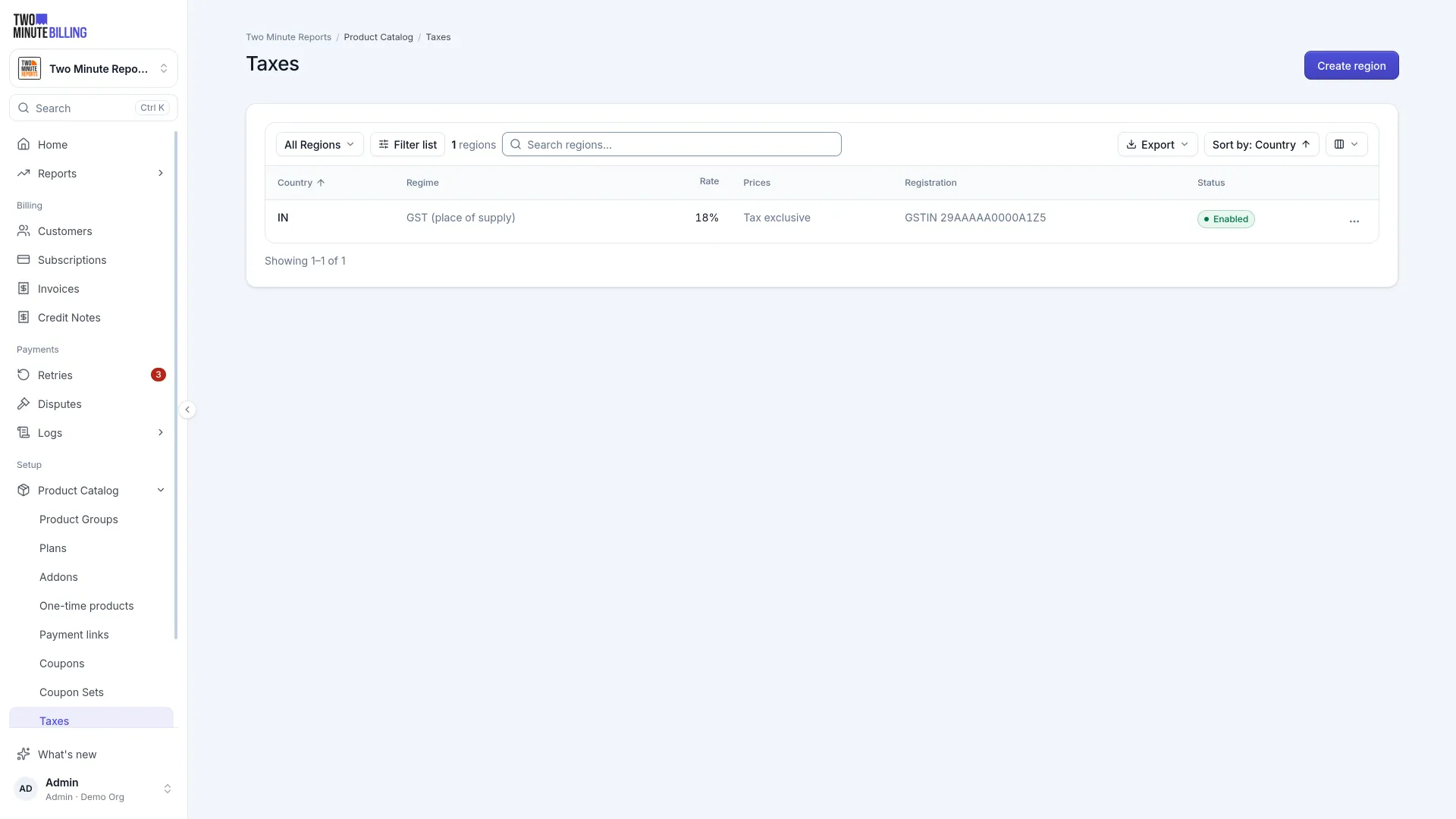
- Go to Settings → Taxes and add a tax region for each country you charge VAT in, with your rate for it.
- Record your VAT registration number.
- On each customer, set their country. For a business, add their VAT number.
- For a business customer in another EU country, select the reverse-charge treatment. For an exempt customer, mark them exempt and record the reason.
- Choose whether your prices include tax or exclude it. A €29.00 price that includes 20% VAT is €24.17 plus €4.83 VAT.
Some things stay with you or your accountant: collecting evidence of each consumer's location, registering for the OSS or in each country, and filing returns. The tax setup guide covers every tax setting in detail. Our page on billing customers in Europe shows how the pieces fit together.
Set up tax
Set up the countries and states you charge tax in, decide whether your prices include tax, and handle exemptions, so each invoice is correct on its issue date.
Checkout and portal
Let customers subscribe and manage their own billing on pages with your brand. Card details never reach your systems and routine changes never reach your inbox.