Whether you charge sales tax on a SaaS subscription depends on the state your customer is in. Each state decides if SaaS is taxable, and some tax only part of the price or only sales to consumers. California, which does not tax SaaS today, starts on January 1, 2027.
Is SaaS taxable in the US?
SaaS is taxable in some US states and not in others, because sales tax is set by each state. According to the US Government Accountability Office, 45 states and DC levy a statewide sales tax, and 37 of those 45 states also allow local sales taxes. So one subscription can carry tax in one state, no tax in the next, and a different local rate in each city.
Each state also describes SaaS in its own words. That wording decides the answer:
- New York taxes "prewritten software" however it is delivered, including remote access (New York Tax Department).
- Texas treats SaaS as a "data processing service" (Texas Comptroller).
- Maryland taxes SaaS as a "digital product" (Comptroller of Maryland). California will do the same from 2027.
- South Carolina taxes SaaS as a "communications service" (South Carolina DOR).
So the useful question is not "is SaaS taxable?" It is "is SaaS taxable in this customer's state, and on how much of the price?"
Which states tax SaaS?
Eight states in the table below tax SaaS in full, including New York, Pennsylvania and Washington. Six tax part of the price or only some buyers, including Texas and Connecticut. Most of the others, including Minnesota and North Carolina, do not tax it.
The states fall into five patterns. Here is one example of each:
- Taxed in full. New York, Pennsylvania and Washington tax SaaS.
- Part of the price. Texas taxes 80% of the charge, because 20% of a data processing charge is exempt.
- A lower rate for business buyers. Connecticut taxes SaaS at 1% when a business buys it for its own use, and at 6.35% otherwise.
- Taxed only for non-business buyers. Iowa and Maryland exclude SaaS that a business buys only for business use.
- Depends on where the server is. Mississippi exempts SaaS only when it is hosted on servers outside the state. Maine does not tax it when it is served from an out-of-state server and nothing is downloaded.
Some answers rest on a ruling, not a rule. A letter ruling answers one taxpayer's question and binds only that case. For Florida, Georgia, Virginia and Oklahoma, the table says what the department has ruled. Illinois rests on a general information letter, which is not binding.
SaaS sales tax by state
| State | SaaS taxable? | Note | Source |
|---|---|---|---|
| California | No today. Yes from January 1, 2027 | Digital products, including SaaS, join the tax base (SB 122) | CDTFA |
| Colorado | No (state tax) | Software from an application service provider is not taxed. The guidance covers state-administered tax, not home-rule cities | Colorado Department of Revenue |
| Connecticut | Partly | 1% when a business buys it for its own use, 6.35% otherwise (from October 1, 2019) | Connecticut DRS |
| District of Columbia | Software: Yes. SaaS not named | The chart lists software (canned, prepackaged or customized) as "taxable as data processing services" | DC Office of Tax and Revenue |
| Florida | No (ruling) | The department has ruled the subscriptions it reviewed are not taxable (TAA 16A-014, 2016). Binds only that taxpayer | Florida Department of Revenue |
| Georgia | No (ruling) | The department has ruled SaaS is not taxable because no tangible property is sold (LR SUT-2019-04) | Georgia Department of Revenue |
| Illinois | No (state tax) | General information letter ST 24-0044-GIL. Not binding | Illinois Department of Revenue |
| Iowa | Partly | Taxable since January 1, 2019. Exempt when a commercial enterprise uses it only for business | Iowa Department of Revenue |
| Kentucky | Yes | "Prewritten computer software access services" are taxable | Kentucky Department of Revenue |
| Maine | No, if the server is out of state | Not taxed when served from an out-of-state server and nothing is downloaded. Taxable on an in-state third-party server (Rule 326) | Maine Revenue Services |
| Maryland | Partly | 6% digital product tax includes SaaS. Excluded when bought only for commercial use in an enterprise computer system | Comptroller of Maryland |
| Massachusetts | Yes | Taxable prewritten software includes "transfers of rights to use software installed on a remote server" | Massachusetts DOR |
| Minnesota | No | "Subscriptions to use online-hosted software are not taxable." | Minnesota Department of Revenue |
| Mississippi | Partly | Since July 1, 2023, exempt only when hosted on servers outside Mississippi | Mississippi DOR |
| Nevada | Electronic delivery: No. SaaS not named | "Products delivered electronically, such as software… are not subject to Nevada Sales or Consumer Use Tax." | Nevada Department of Taxation |
| New Jersey | Mostly no | Most SaaS is not taxed. SaaS that is an "information service" is taxed (TB-72) | New Jersey Division of Taxation |
| New York | Yes | Prewritten software is taxable however it is conveyed, including remote access | New York Tax Department |
| North Carolina | No | "North Carolina does not impose sales or use tax on software as a service." | North Carolina DOR |
| Oklahoma | No (ruling) | The department has ruled electronically delivered prewritten software exempt (LR-26-012, 2026). Only the requester can rely on it | Oklahoma Tax Commission |
| Pennsylvania | Yes | Canned software is taxable however it is accessed, including by subscription (from August 1, 2016). 6% | Pennsylvania Department of Revenue |
| South Carolina | Yes | Taxed as a communications service. A data processing exclusion can apply | South Carolina DOR |
| Tennessee | Yes | Remotely accessed software is taxable from July 1, 2015, at the 7% state rate plus local tax | Tennessee Department of Revenue |
| Texas | Partly | Taxed as a data processing service. 20% of the charge is exempt, so 80% is taxed | Texas Comptroller |
| Vermont | Yes | All prewritten software is taxable from July 1, 2024, including remote access | Vermont Department of Taxes |
| Virginia | No (ruling) | The department has ruled cloud services are treated like downloads and are not taxable (Ruling 24-109, 2024) | Virginia Tax |
| Washington | Yes | Remote access software is subject to sales and use tax | Washington DOR |
| Wisconsin | Partly | Remotely accessed prewritten software can be a taxable digital good (5%). Not when the provider processes the client's data under its own control | Wisconsin DOR |
We list a state only when its own revenue department or legislature states the rule. Every page was checked on November 2, 2026. We will add more states as we check them.
What changes in California on January 1, 2027?
From January 1, 2027, California taxes SaaS. The CDTFA's Special Notice L-1036 says: "Beginning January 1, 2027, the definition of tangible personal property in the Sales and Use Tax Law will be expanded to include digital products." Senate Bill 122 made the change. It was signed into law on June 29, 2026.
The notice defines a digital product as "prewritten computer software transferred on tangible storage media, transferred electronically, or accessed remotely." It names "Prewritten Software-as-a-Service (SaaS) providers" among the businesses affected.
Some things stay outside the tax. The notice lists these:
- "Digital infrastructure (such as cloud platforms that allow customers to create, deploy, or run their own software applications)" is not a digital product.
- "Digital products representing a service, not including SaaS" are exempt.
- "Custom computer software" is exempt.
- "Digital products purchased solely for use outside of California" are exempt.
Three more points from the same notice:
- Local tax. For local and district tax, the place of sale "is generally the customer's address."
- Large buyers. When a retailer's sales of these products to one purchaser "exceed $5 million in a calendar year or preceding calendar year, the tax liability may shift from the retailer to the purchaser."
- Out-of-state sellers. A seller outside California that is engaged in business in the state must register for a Certificate of Registration, Use Tax.
California is not the first state to make this move. Vermont taxes all prewritten software, including remote access, from July 1, 2024 (Vermont Department of Taxes).
Colorado is different. HB26-1223, signed on June 4, 2026, repeals the exemption for downloaded software from January 1, 2027. The bill summary does not mention SaaS.
Which states have no sales tax?
Five states have no statewide sales tax: Alaska, Delaware, Montana, New Hampshire and Oregon (GAO). Two of them still need a second look:
- Alaska has no state sales tax, but it has local sales taxes (GAO).
- Delaware has a gross receipts tax instead (Delaware Division of Revenue).
Montana "does not have a general-use sales tax" (Montana Department of Revenue). Oregon "doesn't have a general sales or use/transaction tax" (Oregon Department of Revenue).
When do you have to collect sales tax in a state?
You must collect sales tax in a state when you have a physical or an economic presence there, also called economic nexus. Your sales into the state can be enough, even if you have no office or staff there.
Until 2018, a seller had to collect only where it had a physical presence. In South Dakota v. Wayfair, Inc., decided on June 21, 2018, the US Supreme Court overruled Quill and National Bellas Hess and ended that rule. South Dakota's law covered sellers that deliver more than $100,000 of goods or services into the state, or make 200 or more separate transactions there, in a year. The Court noted three features of the law: a safe harbor for small sellers, no retroactive collection, and South Dakota's membership in the Streamlined Sales and Use Tax Agreement.
Other states followed. According to the GAO:
- By June 2021, all 45 states with a statewide sales tax, and DC, had economic presence rules for remote sellers.
- As of April 2022, 22 states and DC used a threshold of $100,000 in sales or 200 transactions.
- California, New York and Texas used $500,000.
- Some states have no transaction count at all.
These figures are dated. Each state can change its threshold, so check the state's current page before you decide. If a state taxes SaaS and you pass its threshold, you register there, then collect on sales to customers in that state.
Which rate goes on the invoice?
The customer's location decides the rate. It picks the state, and in many states it picks the local rate too. States use different tests for "location":
- New York: the local rate follows where the buyer uses the software (New York Tax Department).
- Pennsylvania: the location of the sale is the customer's billing address (Pennsylvania Department of Revenue).
- Tennessee: the software is accessed from Tennessee "if a customer's residential or primary business address is in this state" (Tennessee Department of Revenue).
- California (from 2027): for local and district tax, the place of sale "is generally the customer's address" (CDTFA).
Because 37 of the 45 sales tax states allow local taxes (GAO), one state can mean many rates.
Some states also let a business buyer with users in several states pay tax on a share of the price. In Tennessee, the price "may be allocated based on the percentage of users located in Tennessee." Massachusetts applies "apportioned" use tax to software available for use in several places (Massachusetts DOR).
The taxable amount can also differ from the price. In Texas, tax applies to 80% of a data processing charge (Texas Comptroller). The state rate is 6.25% (Texas Comptroller). On a $49.00 plan:
- Taxable amount: $49.00 × 80% = $39.20
- State tax: $39.20 × 6.25% = $2.45
Local tax, where it applies, is added on top.
What about exempt customers?
An exempt customer gives you an exemption certificate, and you charge it no sales tax. The certificate lets a buyer purchase tax-free something that is normally taxable. Nonprofits, government bodies and resellers often use them (GAO).
When you sell to an exempt customer, keep a record that connects each exempt sale to the certificate on file. New York requires sales tax vendors to keep records for at least three years (New York Tax Department).
Business-use rules are a separate thing. They depend on how the buyer uses the software, not on who the buyer is. Iowa (Iowa Department of Revenue) and Maryland (Comptroller of Maryland) exclude SaaS bought only for business use. Connecticut still taxes business use, at 1% (Connecticut DRS).
What must each renewal invoice show?
Each renewal invoice must show the sales tax as its own line. Two states say this plainly:
- New York: always state the sales tax separately on the invoice or receipt, and mark which items are taxable (New York Tax Department).
- Washington: sellers must state retail sales tax separately. If the invoice does not itemize it, the department assumes the tax was not paid (Washington DOR).
A subscription sends a new invoice every period, so build these into every renewal:
- the tax as a separate line;
- the rate used;
- the customer's location that set the rate;
- the exemption reason, when no tax is charged.
Our guide to invoices and credit notes shows how each one is laid out.
What does sales tax look like on a $49 plan?
A Texas seller bills one $49.00 Team plan to three customers. The rates below are rates the seller has set. They show the arithmetic, not a state's current rate. Tax is rounded half-up to the cent.
| Customer | Rate set | Tax | Total |
|---|---|---|---|
| Pennsylvania | 6.00% | $2.94 | $51.94 |
| Washington | 6.50% | $3.19 | $52.19 |
| School district (exempt) | — | $0.00 | $49.00 |
- Pennsylvania: $49.00 × 6% = $2.94.
- Washington: $49.00 × 6.5% = $3.185, which rounds to $3.19.
- School district: no tax. The invoice shows the exemption reason.
How Two Minute Billing handles sales tax
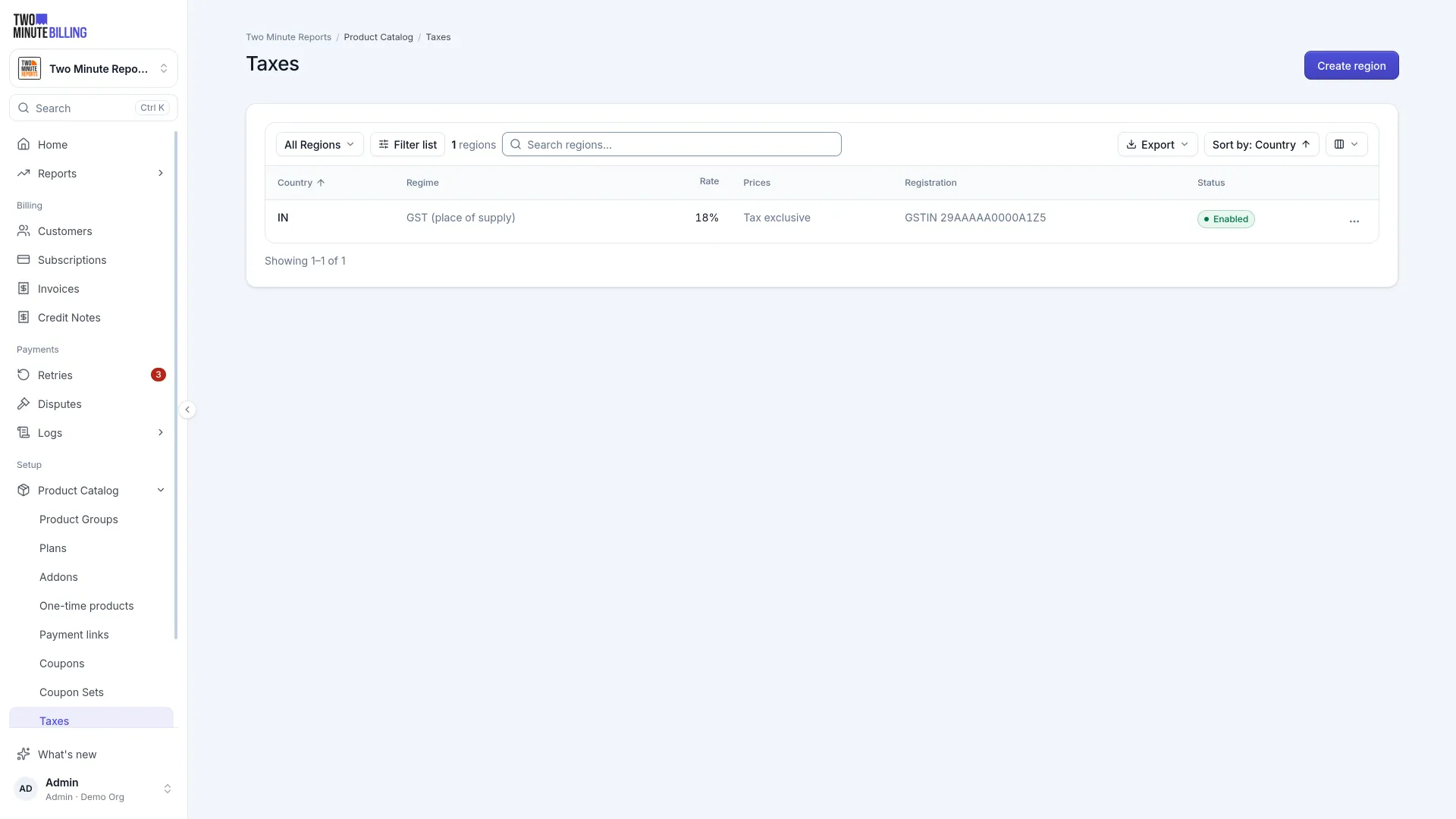
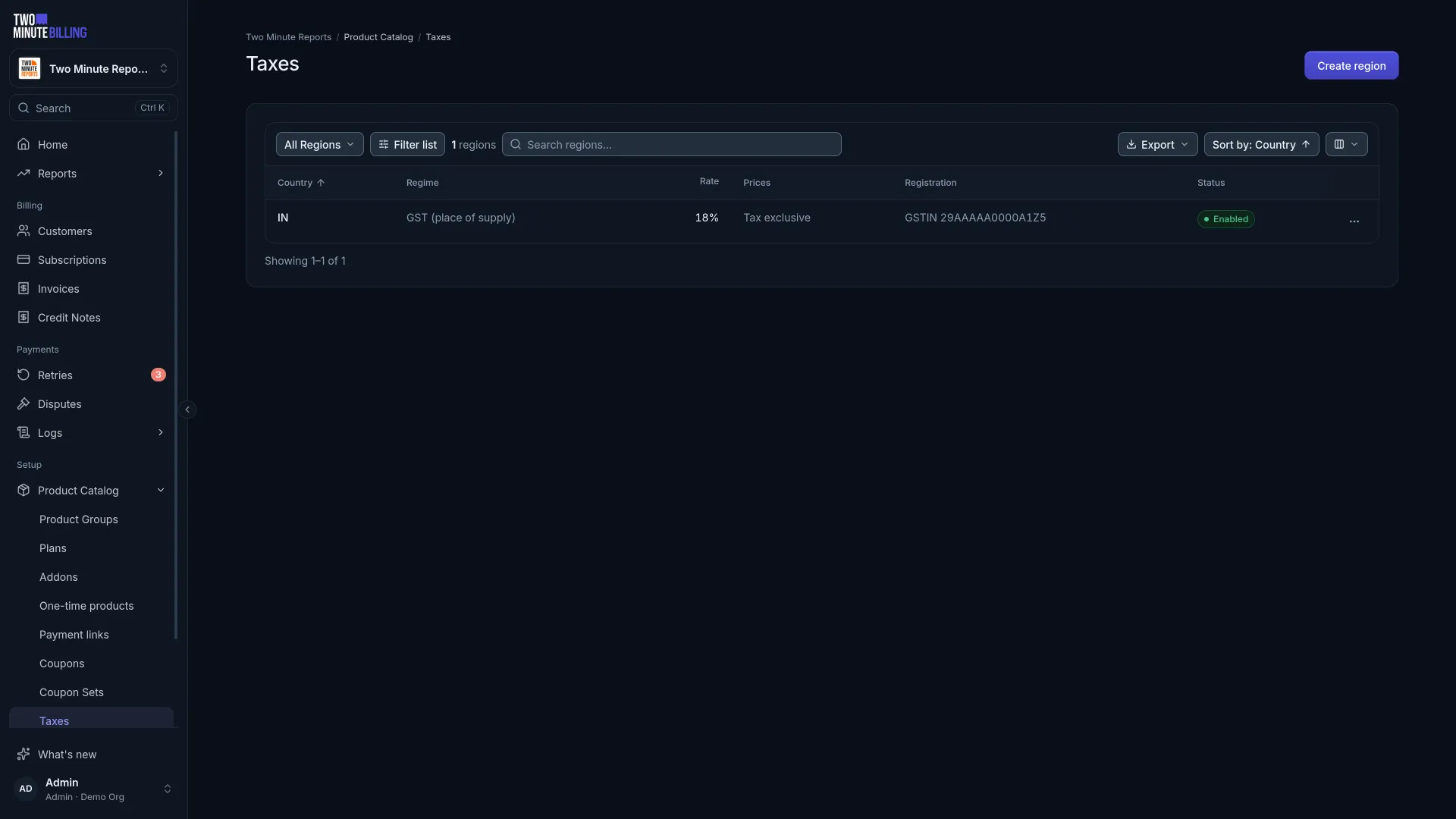
You set one sales tax rate for each state where you collect, and the customer's state decides which rate goes on each invoice. Exempt customers carry no tax, with the reason on record. Each invoice keeps the rate it was issued with, and your prices can include tax or exclude it. Two Minute Billing does not look up rates, handle county, city or ZIP code rates, track where you owe tax, manage exemption certificates, or file returns. For those, work with your tax adviser.
Sources
- California Department of Tax and Fee Administration, Special Notice L-1036 (September 2026), checked
- US Government Accountability Office, GAO-22-106016, Remote Sales Tax: Initial Observations on Effects of States' Expanded Authority (June 14, 2022), checked
- Supreme Court of the United States, South Dakota v. Wayfair, Inc., 585 U.S. 162 (2018), checked
- New York Tax Department, TB-ST-128, Computer software, checked
- New York Tax Department, Recordkeeping requirements for sales tax vendors, checked
- Washington DOR, Digital products including digital goods, checked
- Washington DOR, Sales tax not listed on the invoice, checked
- Pennsylvania Department of Revenue, Sales and Use Tax Bulletin 2016-01, checked
- Texas Comptroller, Publication 96-259, Data processing services, checked
- Texas Comptroller, Publication 94-127, sales tax rate, checked
- Tennessee Department of Revenue, Notice 15-14, Remotely accessed software, checked
- Massachusetts DOR, 830 CMR 64H.1.3, Computer industry services and products, checked
- Connecticut DRS, Special Notice 2019(8), checked
- Colorado Department of Revenue, Sales and use tax topics: computer software, checked
- Colorado General Assembly, HB26-1223, checked
- DC Office of Tax and Revenue, Digital goods sales taxability chart, checked
- Florida Department of Revenue, TAA 16A-014, checked
- Georgia Department of Revenue, LR SUT-2019-04, checked
- Illinois Department of Revenue, ST 24-0044-GIL, checked
- Iowa Department of Revenue, Taxation of specified digital products, software and related services, checked
- Kentucky Department of Revenue, Sales Tax Facts, Winter 2025-2026, checked
- Maine Revenue Services, Rule 326, checked
- Comptroller of Maryland, Business Tax Tip #29, checked
- Minnesota Department of Revenue, Computer software and digital products, checked
- Mississippi DOR, Computer software and digital products notice, checked
- Nevada Department of Taxation, Sales tax FAQs, checked
- New Jersey Division of Taxation, TB-72, checked
- North Carolina DOR, Sales and Use Tax Bulletins 2026, checked
- Oklahoma Tax Commission, LR-26-012, checked
- South Carolina DOR, Policy manual, Chapter 17: Communications, checked
- Vermont Department of Taxes, Prewritten computer software, checked
- Virginia Tax, Ruling of the Tax Commissioner 24-109, checked
- Wisconsin DOR, Publication 240, checked
- Delaware Division of Revenue, Gross receipts taxes, checked
- Montana Department of Revenue, General sales tax, checked
- Oregon Department of Revenue, Sales tax, checked
This post is general information, not tax advice.